The Burnout Society by Byung-Chul Han
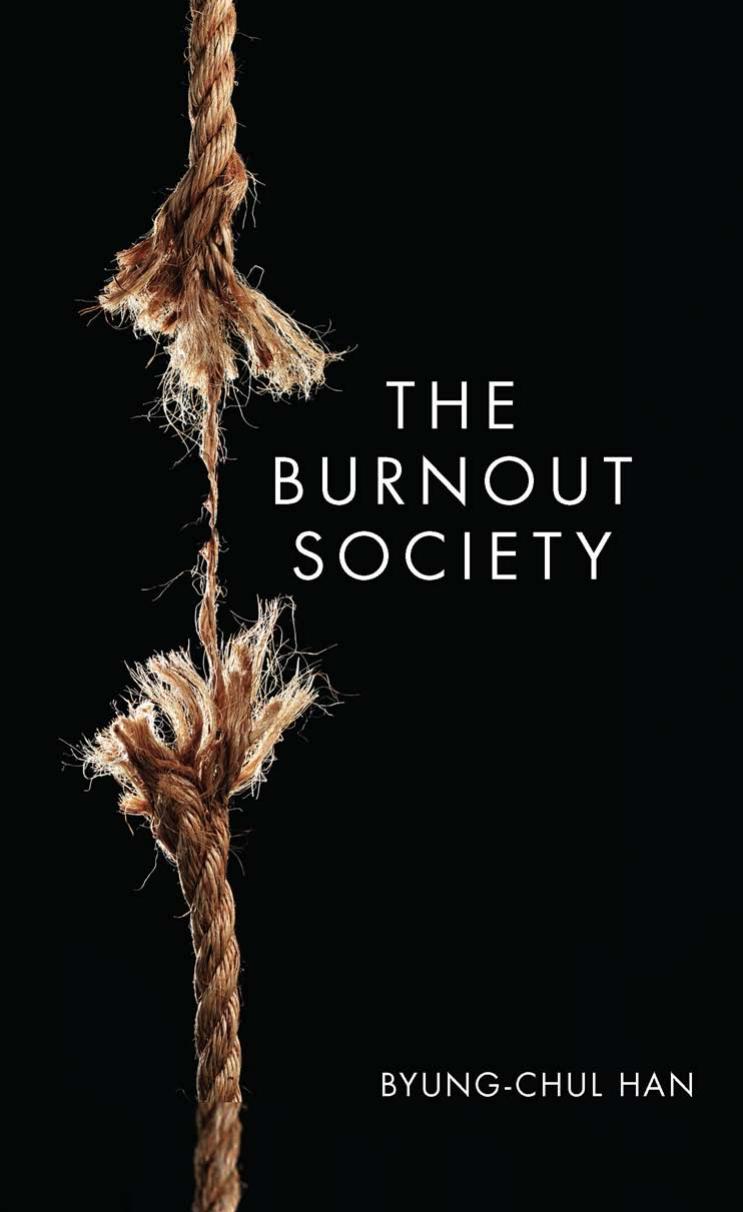
Author:Byung-Chul Han [Han, Byung-Chul]
Language: eng
Format: azw3, epub, pdf
Publisher: Stanford University Press
Published: 2015-08-12T04:00:00+00:00
BURNOUT SOCIETY
In a very cryptic tale—“Prometheus”—Kafka undertakes a few modifications of the Greek legend. His reworking reads, “The gods grew weary, the eagles grew weary, the wound closed wearily.”1 I would subject Kafka’s version to further revision and turn it into an intrapsychic scene: the contemporary achievement-subject inflicting violence on, and waging war with, itself. As everyone knows, Prometheus also brought work to mankind when he gave mortals the gift of fire. Today’s achievement-subject deems itself free when in fact it is bound like Prometheus. The eagle that consumes an ever-regrowing liver can be interpreted as the subject’s alter ego. Viewed in this way, the relation between Prometheus and the eagle represents a relation of self-exploitation. Pain of the liver, an organ that cannot actually experience pain, is said to be tiredness. Prometheus, the subject of self-exploitation, has been seized by overwhelming fatigue.
For all that, Kafka envisions a healing tiredness: the wound closes wearily. It stands opposed to “I-tiredness,” whereby the ego grows exhausted and wears itself down; such tiredness stems from the redundancy and recurrence of the ego. But another kind of tiredness exists, too; here, the ego abandons itself into the world [das Ich verläßt sich auf die Welt hin]; it is tiredness as “more of less of me” [Mehr des weniger Ich], healthy “tiredness that trusts in the world.”2 I-tiredness, as solitary tiredness, is worldless and world-destroying; it annihilates all reference to the Other in favor of narcissistic self-reference.
The psyche of today’s achievement-subject differs from the psyche of the disciplinary subject. The ego, as Freud defines it, is a well-known disciplinary subject. Freud’s psychic apparatus is a repressive apparatus with commandments and prohibitions that subjugate and repress. Like disciplinary society, the psychic apparatus sets up walls, thresholds, borders, and guards. For this reason, Freudian psychoanalysis is only possible in repressive societies that found their organization on the negativity of prohibitions and commandments. Contemporary society, however, is a society of achievement; increasingly, it is shedding the negativity of prohibitions and commandments and presenting itself as a society of freedom. The modal verb that determines achievement society is not the Freudian Should, but Can. This social transformation entails intrapsychic restructuring. The late-modern achievement-subject possesses an entirely different psyche than the obedience-subject for whom Freud conceived psychoanalysis. Freud’s psychic apparatus is dominated by negation [Verneinung], repression, and fear of transgression. The ego is a “seat of anxiety” [Angststätte].3 In contrast, the late-modern achievement-subject is poor in negation. It is a subject of affirmation. Were the unconscious necessarily connected to the negativity of negation and repression [Verdrängung], then the late-modern achievement-subject would no longer have an unconscious. It would be a post-Freudian ego. The Freudian unconscious is not a formation that exists outside of time. It is a product of the disciplinary society, dominated by the negativity of prohibitions and repression, that we have long since left behind.
The work performed by the Freudian ego involves the fulfillment of duty, above all. On this score, it shares a feature with the Kantian obedience-subject.
Download
The Burnout Society by Byung-Chul Han.epub
The Burnout Society by Byung-Chul Han.pdf
This site does not store any files on its server. We only index and link to content provided by other sites. Please contact the content providers to delete copyright contents if any and email us, we'll remove relevant links or contents immediately.
| Anthropology | Archaeology |
| Philosophy | Politics & Government |
| Social Sciences | Sociology |
| Women's Studies |
Cecilia; Or, Memoirs of an Heiress — Volume 1 by Fanny Burney(32635)
The Great Music City by Andrea Baker(32607)
Cecilia; Or, Memoirs of an Heiress — Volume 2 by Fanny Burney(32010)
Cecilia; Or, Memoirs of an Heiress — Volume 3 by Fanny Burney(31996)
We're Going to Need More Wine by Gabrielle Union(19107)
All the Missing Girls by Megan Miranda(16306)
Pimp by Iceberg Slim(14661)
For the Love of Europe by Rick Steves(14562)
Bombshells: Glamour Girls of a Lifetime by Sullivan Steve(14135)
Norse Mythology by Gaiman Neil(13457)
Talking to Strangers by Malcolm Gladwell(13438)
Fifty Shades Freed by E L James(13289)
Mindhunter: Inside the FBI's Elite Serial Crime Unit by John E. Douglas & Mark Olshaker(9418)
Crazy Rich Asians by Kevin Kwan(9345)
The Lost Art of Listening by Michael P. Nichols(7547)
Enlightenment Now: The Case for Reason, Science, Humanism, and Progress by Steven Pinker(7353)
The Four Agreements by Don Miguel Ruiz(6827)
Bad Blood by John Carreyrou(6669)
Weapons of Math Destruction by Cathy O'Neil(6362)
